Hurricane Hotspots
The Worst Places for Hurricanes

By now, everyone knows that the last two hurricane seasons have been particularly severe. Severe yes, but compared to what?
Hurricane experts are saying we had just grown accustomed to a level of hurricane activity that had been unnaturally low, with relatively few major hurricanes hitting Florida and the East Coast of the United States in the last 30 years. Now they say the pendulum may be swinging in the other direction, bringing a greater than normal number of major storms.
According to the hurricane forecasters, we should be prepared for increased major hurricane activity over the next two or three decades. This year’s hurricane season is not yet over, but it’s already the most costly on record.
So, should you cancel that Florida vacation, or re-think your retirement plans? By analyzing the tracks of tropical storms for the past 100 years, the experts at Sperling’s BestPlaces have ranked which areas are most likely to be hit next by a major hurricane.
-
Southeast Florida (Miami-Fort Lauderdale-West Palm Beach)
-
Key West and the Florida keys
-
Southwest Florida (Fort Myers-Naples)
-
West Florida (Tampa-St. Petersburg-Sarasota-Clearwater)
-
Outer Banks islands, NC (Cape Hatteras)
-
Central Texas Gulf coast (Galveston)
-
Central Florida Atlantic coast (Melbourne-Cocoa Beach)
-
Florida Panhandle (Pensacola-Panama City)
-
Central Gulf coast (New Orleans, LA-Biloxi, MS-Mobile, AL)
-
South Texas Gulf coast (Corpus Christi-Brownsville)
Does this mean newcomers are likely to avoid these hurricane-prone areas? Research expert Bert Sperling says recent hurricane activity is having an impact. "In spite of a devastating 2004 season, coastal areas still had tremendous appeal. But this year's new wave of hurricane activity has caused some people to have second thoughts. If the hurricane activity continues at this pace, it will have a significant impact on where people choose to live or if they will rebuild in the same location."
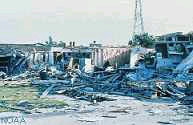
Our list focuses on coastal areas, where the effects of a hurricane can be most catastrophic. In addition to the devastation caused by high winds of 200 mph or more, the ocean itself may be driven inland by the winds, creating a "storm surge", a wall of water up to 20 feet high.
1) Southeast Florida
This area includes the major cities of Miami, Fort Lauderdale, and West Palm Beach. Forecasters estimate that once every ten years, it will be visited by a hurricane of a Category 3 or greater (winds over 111 miles per hour). The most recent such hurricane was Andrew in 1992, a Category 5 monster, so Miami is several years overdue for a major hit. Hurricane Jeanne hit the area as a Category 2 storm in 2004.
2) The Florida Keys
The town of Key West is at the end of this island chain off the southern tip of Florida. It is exposed on all sides to passing hurricanes. It was last hit by a Category 1 hurricane in 1999 and a Category 2 storm in 1998, and narrowly escaped a direct hit by Hurricane Rita in 2005.
3) Southwest Florida
Florida’s southern Gulf coast is home to the metro areas of Fort Myers and Naples. In 2004, a Category 4 hurricane named Charley slammed ashore a few miles north of Fort Myers.
4) West Florida
Tampa was most recently hit in 2004 by hurricane Frances after it crossed over the state of Florida. Though diminished in intensity after its journey over land, Frances still packed high winds and heavy rainfall. The Tampa area includes the cities of St. Petersburg, Sarasota, and Clearwater.
5) Outer Banks islands, NC
This sparsely inhabited area sticks out into the Gulf Stream, creating an area of frequent landfall for hurricanes sweeping up the Atlantic coast.
6) Central Texas - Gulf coast
The island city of Galveston has been the site of some of the most catastrophic hurricanes in the last century. It was last hit by a hurricane in 1989, but tropical storm Allison delivered extremely heavy rainfall to the area in 2001, including Houston inland.
7) Central Florida – Atlantic coast
The hurricane threat diminishes north of the Miami area, in the cities of Melbourne, Cocoa Beach, and Cape Canaveral. Hurricane Frances made landfall here in 2004 as a Category 2 storm.
8) Florida Panhandle
In 2004, hurricane Ivan slammed into the area with Category 3 force. The metro areas of Pensacola and Panama City were hit hard in 1995 by hurricane Opal, which packed winds of 125 mph.
9) Central Gulf coast
We will all remember the name of Hurricane Katrina, the Category 4 storm that destroyed much of New Orleans and Gulfport, Mississippi. The Central Gulf Coast, including the major cities of New Orleans (LA), Biloxi (MS) and Mobile (AL), is vulnerable to another major hurricane. In 1969, Camille devastated the area as one of only three Category 5 hurricanes to strike the U.S. mainland. In 2004, Ivan narrowly missed Mobile as a Category 3 storm, and Ivan made landfall at Gulf Shores, Alabama.
10) South Texas – Gulf coast
This region was last hit in 1999 by Bret, a rare Category 4 hurricane. Fortunately, Bret struck in a sparsely populated area between Corpus Christi and Brownsville. This region has avoided a catastrophic hurricane in recent years.
Hurricanes can hit anywhere along the Gulf Coast and Atlantic seaboard. Other hotspots include (in order of decreasing probability) Jacksonville, FL, Savannah, GA, Charleston, SC, Wilmington, NC, Norfolk, VA, and even Providence, RI. See also: the likelihood of hurricanes in New England, Hawaii, and California.
Between 1965 and 2004 (nearly 40 years), the Florida peninsula had only one major hurricane that made landfall (hurricane Andrew in 1992). The normal long-term probability of an intense hurricane hitting somewhere in Florida or on the East Coast is about once every three years. The odds are slightly better for the Gulf Coast, from the Florida Panhandle through the Texas coast.
If hurricane frequency increases to normally active levels, residents of Southern coastal areas will need to prepare the new onslaught. Sperling suggests, “Minimize your risk by doing your homework before you move. Use care to research the location of your new home, and how it is constructed. A little work now may save your home and possessions, and your lives.” See also: our tips for hurricane preparedness.
Sources
We analyzed tracks of tropical storms from the National Hurricane Center, which is part of the Tropical Prediction Center at the National Weather Center. We consulted hurricane predictions which were jointly developed by scientists from the NOAA Climate Prediction Center, the Hurricane Research Center, and the National Hurricane Center. We also found the “United States Landfalling Hurricane Probability Project” very informative, developed by Dr. William Gray’s Tropical Meteorology Research Project at Colorado State University.